

Major League Soccer announced last week that it will shift to a July-to-May calendar starting with the 2027-28 season, marking one of the most significant structural changes in league history. After a lengthy review process, MLS will abandon its traditional February-to-December schedule to align with top leagues globally.
The strategic rationale is clear: better alignment with international transfer windows, reduced conflicts with FIFA calendars, and improved playoff positioning away from NFL dominance. But the business reality is more complex. This shift creates both opportunities and challenges for the league, its broadcast partners, and brand sponsors navigating an already-crowded American sports calendar.
The Sports Calendar Reality Check
To understand what MLS is really up against, we analyzed activity across 14 major sports properties throughout the calendar year. By mapping when each property is active and calculating the percentage of peak sports activity by month, we can see exactly when MLS will be competing for attention.
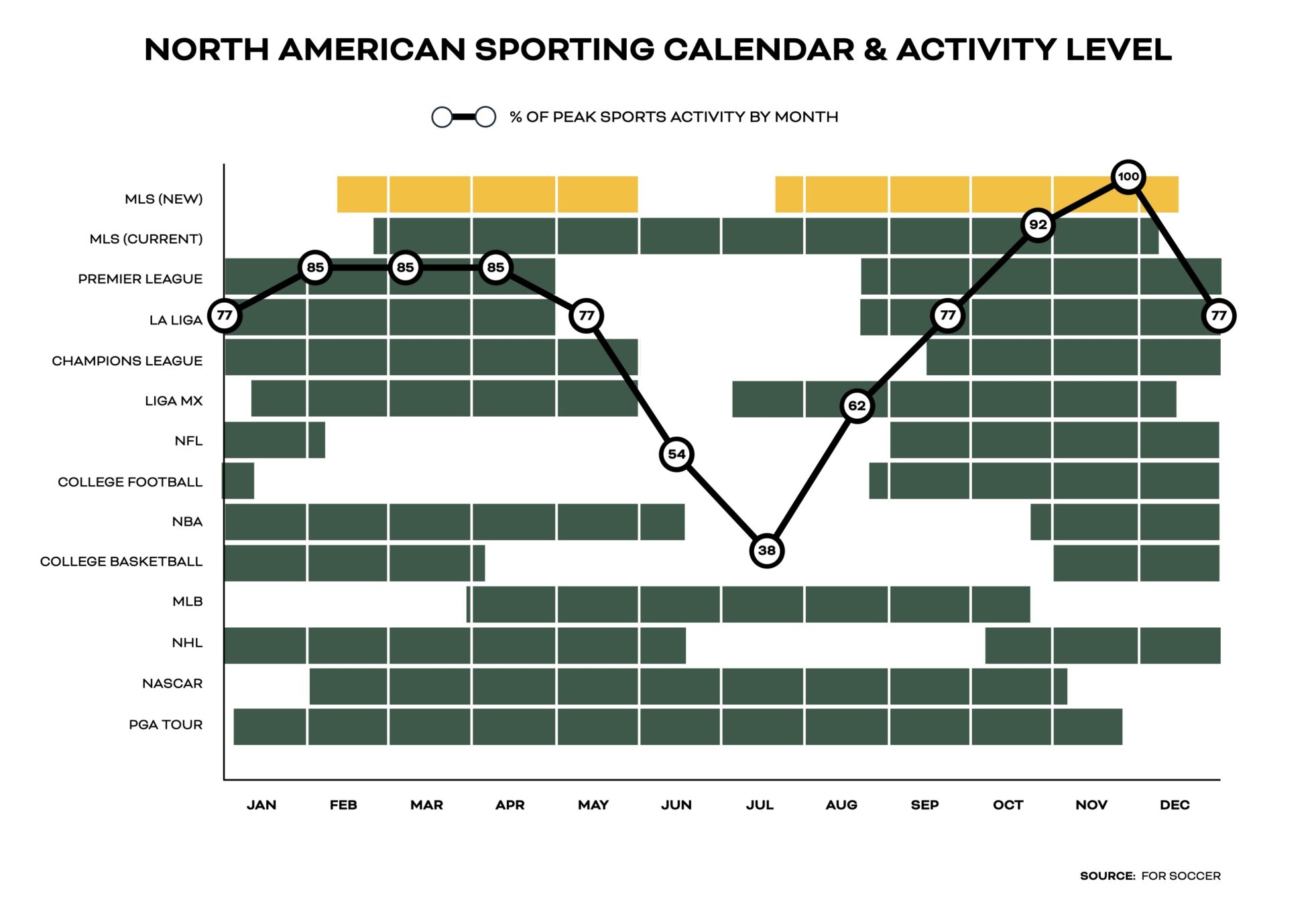
The data reveals three critical windows after reviewing active periods for the NFL, College Football, NBA, College Basketball, MLB, NHL, MLS, Premier League, LaLiga, Champions League, Liga MX, PGA Tour, and NASCAR.
July Launch: The Summer Desert 🏜️
When MLS kicks off its new season in mid-to-late July, it enters the quietest period of the American sports calendar at just 38% of peak activity. MLB is the only major property in full swing, with NASCAR and the PGA Tour providing background competition. European soccer is dark. American football hasn’t started. Basketball and hockey are months away. This is the cleanest launch window MLS could ask for.
Regular Season: Peak Competition Returns ⛰️
By September, October, and November, MLS finds itself in the thick of peak competition. This is when the American sports calendar fires on all cylinders: NFL and college football dominate weekends, NBA and NHL start up, MLB enters pennant races and playoffs, and European soccer seasons start anew.
Under the old calendar, MLS was competing in this same window. The new calendar doesn’t change this reality, it just means MLS enters peak competition after establishing momentum in the summer rather than trying to fight through it from the season’s start.
May Playoffs: The New Showcase 🏆
Perhaps the most significant shift is moving MLS Cup from early December to late May, when MLS playoffs and MLS Cup will compete with:
- NBA Conference Finals and potentially NBA Finals
- NHL Conference Finals and potentially Stanley Cup Finals
- MLB’s early season
- European league season conclusions
- Champions League Final
MLS avoids direct conflict with NFL and college football, which dominate American sports conversation in ways that basketball and hockey, despite their playoff intensity, do not. The playoffs also get more ideal weather conditions and remain uninterrupted by FIFA international windows.
The Winter Break Strategy ❄️
By going dark from mid-December through early February (with no games in January), MLS makes a strategic retreat during the most crowded period of the American sports calendar. January has NFL playoffs, College Football Playoff championship, peaking NBA and NHL seasons, and college basketball in full swing.
Rather than fight for scraps of attention during this period, MLS cedes the ground entirely and acknowledges the league can’t compete with the NFL playoffs and College Football Playoff—so why try?
Brand Partnership Implications
Since we live in the brand space, the obvious question arises as a result of this seismic shift: what are the implications for how league and team partners activate their MLS sponsorships?
Activation Timing Shifts 📅
Season launch campaigns move from February (late winter) to July (peak summer). Playoff campaigns move from November-December (holiday season, cold weather in many markets) to April-May (spring, better weather). This can change a lot from creative messaging to experiential event planning.
Summer launch activation aligns with different consumer behaviors: travel season, outdoor activities, back-to-school preparation. December holiday activations offered built-in seasonal hooks. May playoff activations compete with end-of-school-year activities and Memorial Day weekend.
For partners whose products or services have seasonal demand curves, these shifts may matter. A beer sponsor might love summer activations, but find May playoffs less compelling than December games. An apparel sponsor might find the opposite.
The Winter Break Gap ⏳
How do partners maintain brand presence during the two-month winter break? Under the old calendar, MLS was active in one continuous season within a calendar year. The new calendar creates a mid-season pause when the league goes dark while partner sponsorship commitments remain active.
Smart partners will develop winter break programming: player features, behind-the-scenes content, community engagement, anticipation-building for the season’s second half. But this requires strategic planning and potentially additional investment to maintain momentum during the dark period.
Global Brand Coordination 🌎
For multinational brands sponsoring multiple soccer properties globally, calendar alignment creates a critical trade-off.
The upside: coordinated campaigns across markets when both MLS and European leagues are active simultaneously. Brands can synchronize messaging, creative assets, and promotional timing rather than running separate calendar cycles.
The downside: loss of year-round soccer coverage. Previously, MLS’s February-December schedule complemented European soccer’s August-May calendar, creating nearly continuous activation opportunities. When European leagues went on summer break, MLS was in full swing.
For brands valuing a continuous soccer presence and constant visibility in the sport year-round, this alignment reduces total annual exposure. A global apparel brand previously could run soccer campaigns 11-12 months annually. In the future they’ll face gaps.
Strategic Bet on Global Integration
The calendar shift represents MLS prioritizing long-term global competitiveness over short-term domestic comfort. By aligning with the global calendar, MLS is betting that improved access to the transfer market, better integration with international club competitions, and reduced conflicts with national team obligations will outweigh the challenges of navigating the American sports calendar differently.
For brand partners, the message is clear: prepare for a transition period with inherent uncertainty but potential upside if the global integration strategy works. The partners who will extract the most value are those who remain flexible, plan for multiple scenarios, and resist the temptation to view this purely through the lens of domestic sports competition.
The American sports calendar data shows us that MLS isn’t escaping competition. Instead, it’s repositioning when and how it competes. Whether that repositioning creates business value for the league and its partners will depend on execution during a complex, uncertain transition period that extends well beyond just changing the calendar dates.